Help on the automatic multilingual summarization software
SummarizOR
Advanced summarization mode
Table of Contents
- To summarize clipboard contents
- Summarizing a document from a URL (Internet or Web page)
- Summarizing a file from various supports: PC hard disk, USB key, CD, or DVD
- SummarizOR's command bar
- SummarizOR's advanced functionalities
- Choice of language
- Sentences display
- User keywords
- Domain
- AIExtracteur — Advanced Concept Analysis
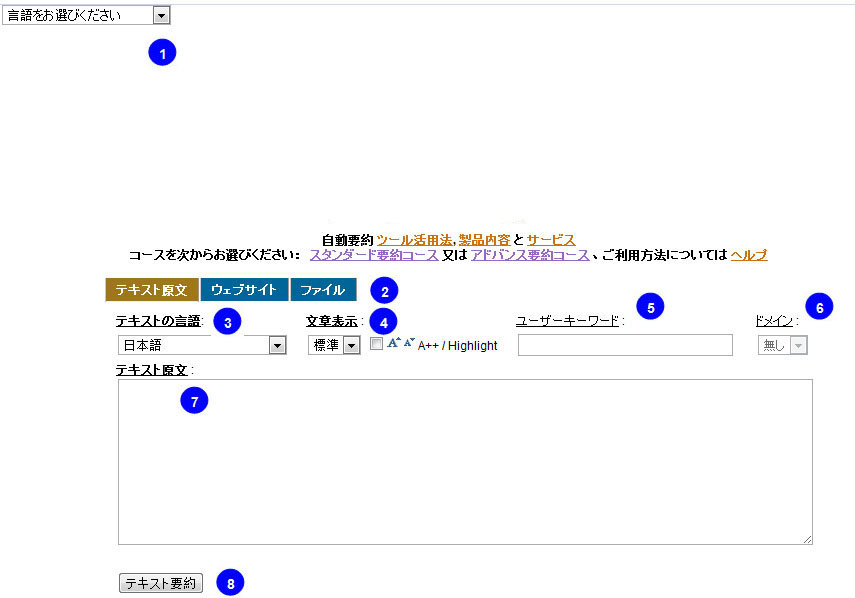
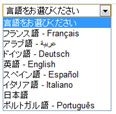
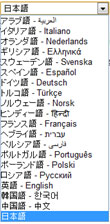
 Choose the language interface of SummarizOR
 You can summarize automatically various types of documents from various sources, with the following options :

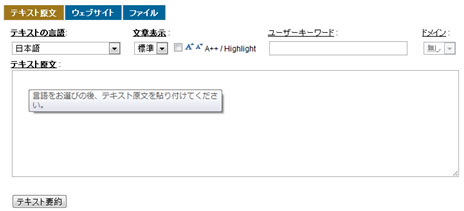
Text" : clipboard contents (cut and paste);
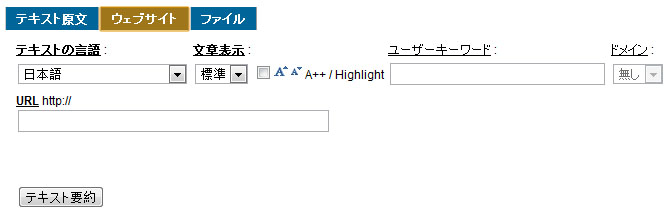
"Web page" : contents of page or under a URL on a network such as the Internet, or an intranet or extranet;
"File" : document coming from various supports including PC hard disks, USB key, CD, DVD ...
 Select the language of the source text to summarize
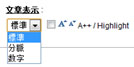
 Select the desired display mode
 Enter words or expressions between quotes " "

 Select the field of your source text

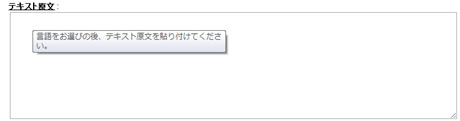
 Paste the source text into the window below
 Simply click the
 button and proceed with SummarizOR’s command bar below.
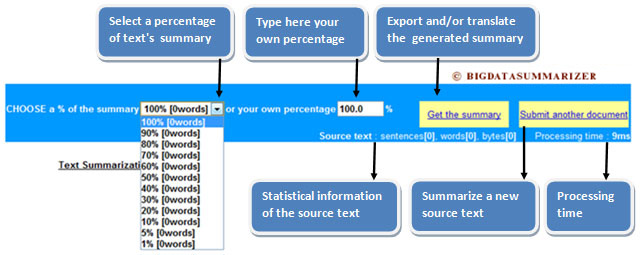
 SummarizOR’s command bar
Using SummarizOR software (detailed version)
You can summarize automatically various types of documents from various sources, with the following options :
-
"Text" : clipboard contents (cut and paste);
"Web page" : contents of page or under a URL on a network such as the Internet, or an intranet or extranet;
"File" : document coming from various supports including PC hard disks, USB key, CD, DVD ...
To summarize clipboard contents :
Paste the text into the specific window. Simply click the
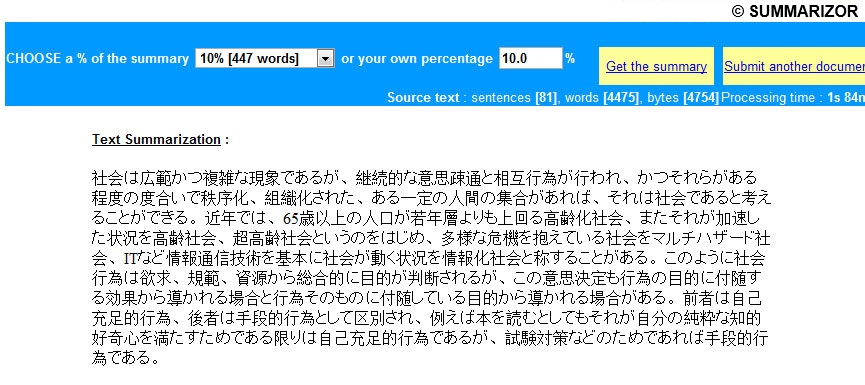
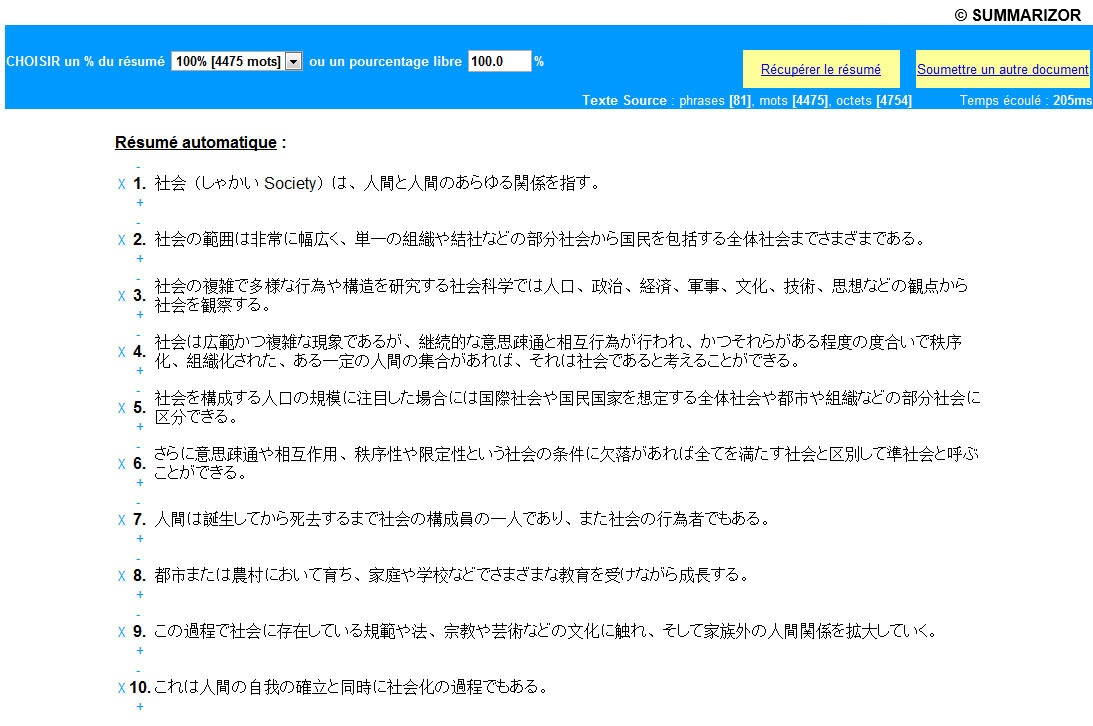
The summary is then displayed, along with additional information including: numbers of sentences, of words and of characters (bytes) of the summary, and processing time.
The summary can be exported (or saved) by copying viaand pasting.
Note that this also applies to the other two ways of acquiring a document – ” Web page” and” File”.
Summarizing a document from a URL (Internet or Web page) :
Enter the URL / Internet address of the Web page (include http://) and click on the) and click on theSummarizing a file from various supports; PC hard disk, USB key, CD, or DVD :
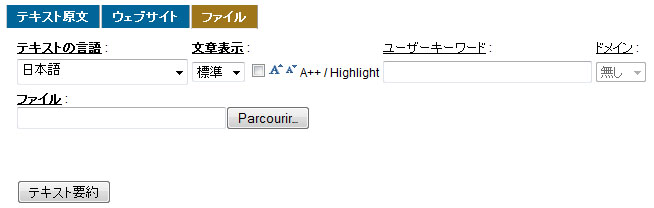
Click on “Browse” and select a file, then click on theSummarizOR’s command bar :
SummarizOR’s advanced functionalities :
Advanced functionalities give rapid access to the information, maintaining sufficient coherence for the comprehension of the summary.A. Choice of language :
A drop-down list lets you choose the language of the source text.B. Sentences display :
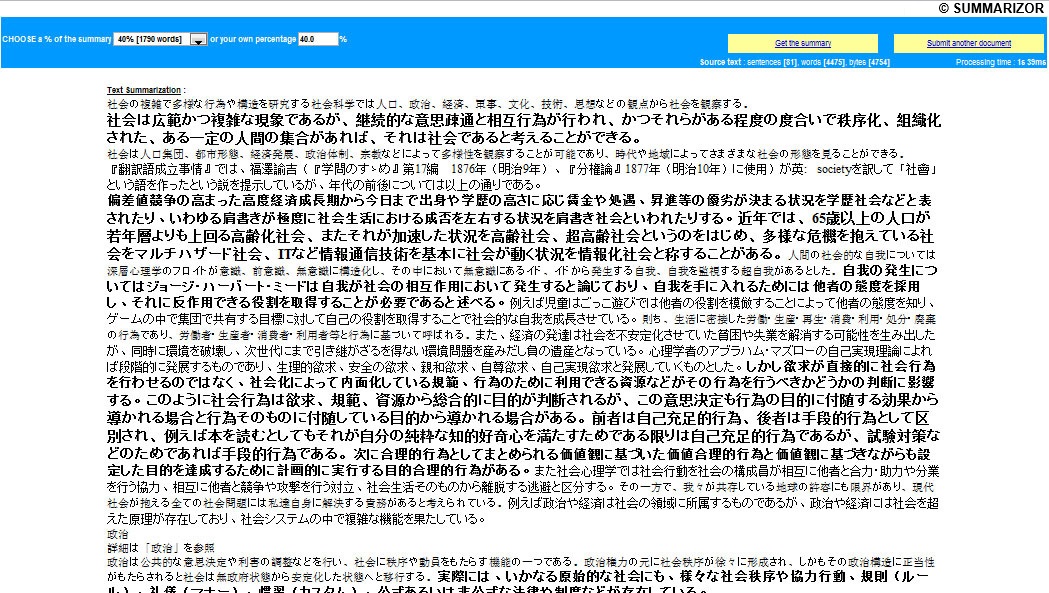
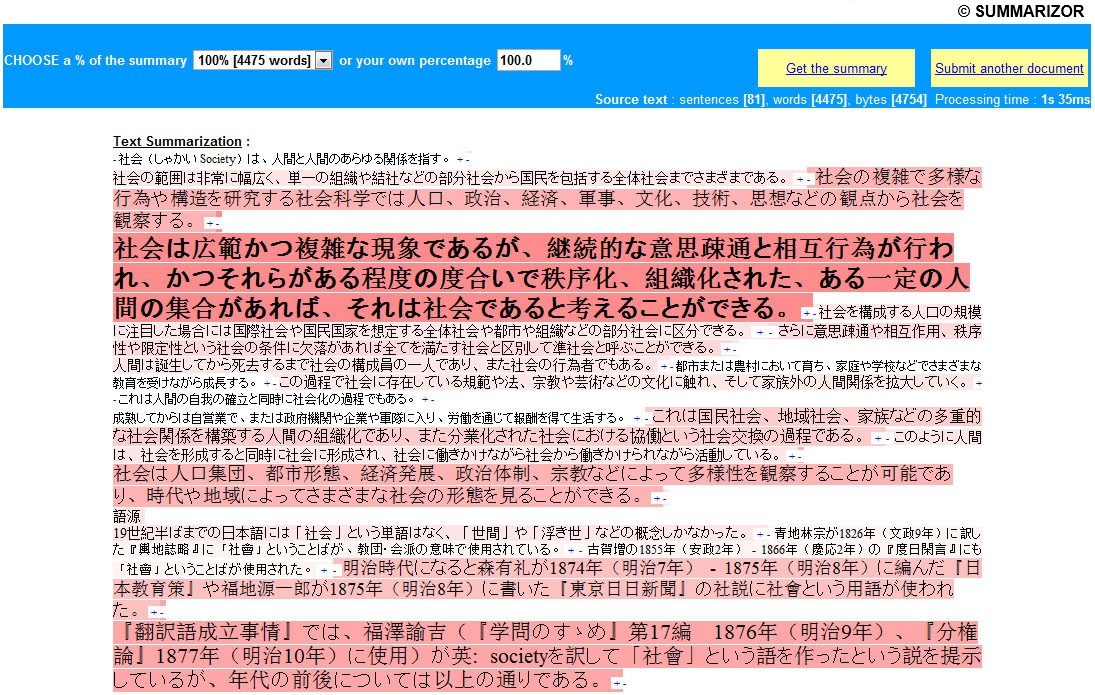
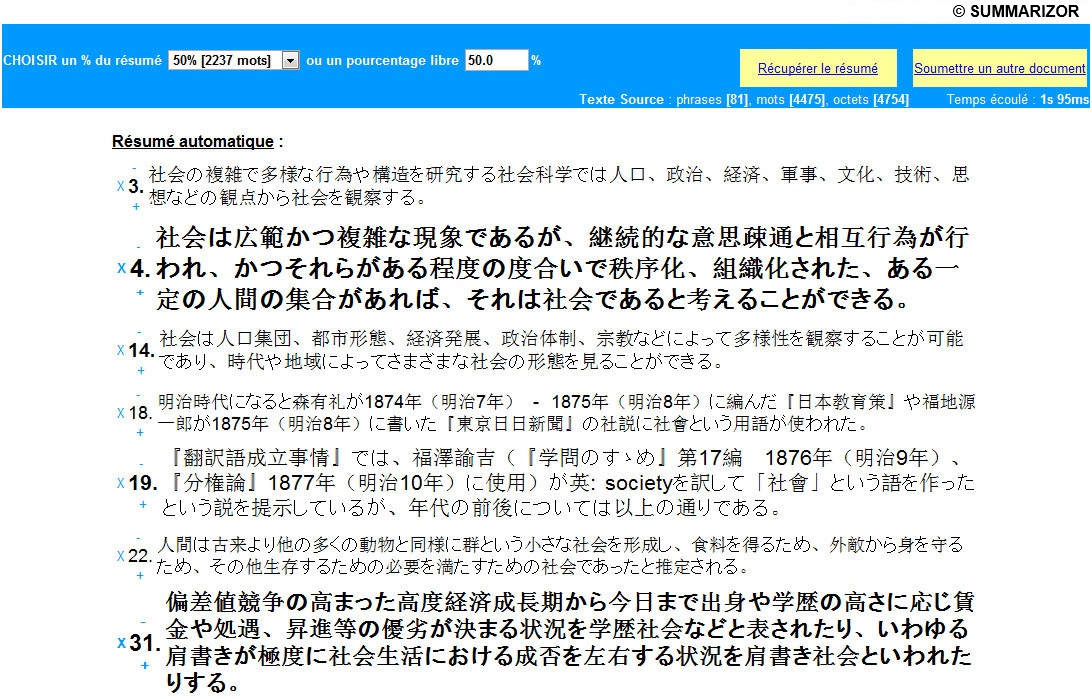
Three views are provided. “standard”, “context” and “numbered”, each declined in two variants governed by the checkbox
“Standard” mode :
: if the box is unchecked, the processing does not alter the source text.
Example :
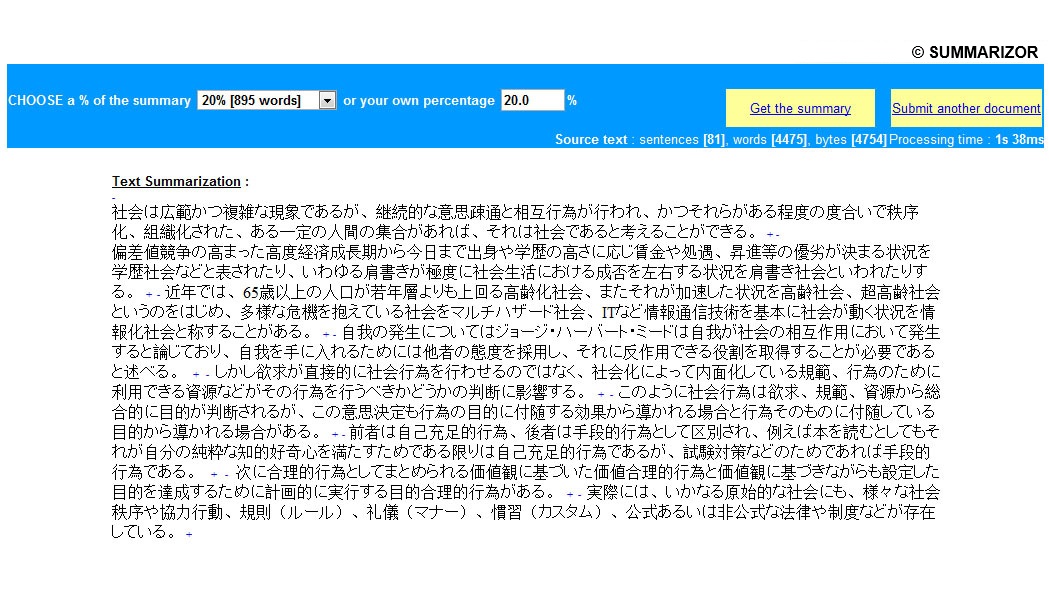
: if the box is checked, the sentences of the source text and the summary are presented in the form of a particular display.The sentences that are likely to convey important information are displayed in larger characters. Conversely, those likely to convey information with less importance are displayed in small characters. In this innovative display mode, the user can visually scan with ease, giving more attention to the larger-scale passages in the document and its summary.
Example:
"Context" mode :
Example :
Example :
Example :
Example :
C. User keywords :
You can enter words or expressions (between quotes). After generating the summary, the program provides the number of occurrences of the words or expressions entered and found in the source text. You can navigate across their occurrences using the spacebar. The words or expressions you have selected are taken into account for the selection of the sentences that make up the summary.
D. Domain :
SummarizOR can integrate various domain dictionaries, lexicons or thesauri to give more relevance to the summary. For each term actually found in the source text, it provides the corresponding number of occurrences, and you can navigate them using the spacebar. In some domains, you can also navigate across the synonyms of the terms.
6. AIExtracteur — Advanced Concept Analysis :
After each automatic summary, the AIExtracteur bar appears at the bottom of the interface. It offers five complementary concept-analysis tools, built from the key concepts extracted from the summarized text. Run a summary first to activate concept analysis (Text, URLs, Web Page or File tab).
A. Concept Map (domains) : the Concept Map displays the domain terms identified by SummarizOR in the summarized text. Clicking a concept takes you directly to its first occurrence in the text. The Tab key then lets you navigate from one occurrence to the next.
B. User Concepts : User Concepts visualize the keywords you have defined, weighted by their frequency and importance in the summary. Clicking a concept triggers the same navigation: click → first occurrence → Tab.
C. SummarizOR AImindMap : SummarizOR AImindMap is made up of all extracted concepts — domain and user — and opens the way to unmatched cognitive use: global visualization, easier memorization, intuitive navigation through the document's main ideas.
D. Statistics : the Statistics panel provides four complementary charts that analyze the distribution of the extracted concepts:
Chart 1 — Term frequency : histogram of concept occurrences in the source text.
Chart 2 — Domain distribution : breakdown of concepts by specialty domain.
Chart 3 — Condensation curve : change in summary ratio according to the number of sentences retained.
Chart 4 — Semantic weight : ranking of terms by importance score computed by SummarizOR.
E. Data Import : Data Import lets you import an external file (TXT, CSV…) to extract and analyze its concepts independently of the current summary.
F. Free Word Cloud : Free Word Cloud generates a custom cloud from text or a list of terms entered freely by the user, independently of any summary.